Checked 22 September 2026
Lapidary trim saws and slab saws
A trim saw cuts small shapes from a flat slice of stone. A slab saw cuts a larger stone into those slices. Blade size matters, but the way the saw holds and moves the stone sets the size it can cut safely.
What each saw does
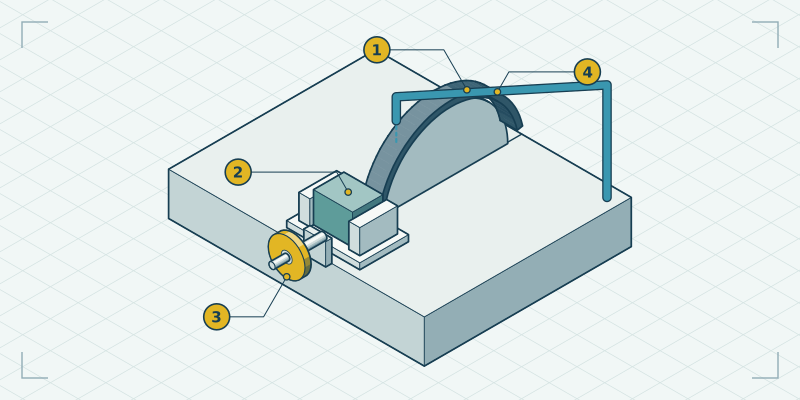
A trim saw removes waste around a marked cabochon or cuts a small piece of rough into manageable parts. A slab saw makes repeated, roughly parallel cuts through larger rough. Bigger blades allow deeper cuts, but a large blade alone does not turn a hand-fed trim saw into a production slab saw. Vise opening, feed travel, table, blade exposure and coolant system all limit the useful cut.
The labels vary by maker. Hi-Tech Diamond calls its 10-inch machine a slab saw; Covington calls its 10-inch machine a trim saw and equips it with a vise, cross-feed and power feed. Compare the workholding and feed, not the name on the listing.
Four current configurations
| Machine | Cutting setup | What to verify |
|---|---|---|
| Hi-Tech 6-inch trim saw | Variable-speed, water reservoir; optional manually advanced vise | Blade type, 5/8-inch arbor and included vise |
| Hi-Tech 10-inch slab saw | Removable table and optional manually advanced vise | Workpiece clearance and the two supplied blade types |
| Covington 1510 trim saw | Vise, 3½-inch cross-feed and power feed | Hood, coolant route and exact package |
| Highland Park HT14 slab saw | Cross-feed vise, power feed and automatic cutoff | Jaw opening, 5/8-inch blade arbor and manual |
The Hi-Tech 10-inch saw is offered with or without a vise; with the vise fitted, the operator still advances the carriage by hand. Covington's 1510 uses a power feed. The difference matters if you expect the saw to make repeated slabs while you prepare the next piece.
Measure the rock and the machine
Record the rough's largest cross-section and the slab thickness you want. Then compare them with the saw's stated workpiece opening, blade exposure, vise travel and table clearance. A 14-inch blade does not provide seven inches of usable depth: its arbor, guard and table consume part of the radius. The HT14 listing, for example, gives a 5½ by 7-inch maximum vise opening.
Check the saw's blade diameter and arbor together. A thinner blade may waste less material, but it needs suitable support, feed and coolant. The blade and coolant guide explains those measurements. Use the machine manual for guards, coolant level, feed rate and electrical setup. Keep fingers out of the blade path; a vise is useful when the piece is hard to hold safely.
Identify an older saw before ordering parts
Parts suppliers still use the model codes of older saws. Covington's 2010/11 catalogue sold the 1508 and 1510 trim saws with 8- and 10-inch blades, a 5/8-inch arbor, 3½ inches of cross-feed and a weight or power feed; the same page shows a 1-inch arbor on the 700-series and larger slab saws. Its 1100-series saws took 12- to 16-inch blades and converted from slab to trim saw with a drop-in table.
Raytech's 2000–01 price list names its AL-P10S and AL-P10T 10-inch saws. Diamond Pacific's 2005 catalogue lists parts for its TC-6, TC-10, TC-14, 10TS-B, TR-18 and TR-24 saws. It sold a hydraulic cylinder and pump for the TR-24 but a feed pawl for older screw-feed TR models, so check which feed a used TR saw has. The same page lists split nuts in five thread sizes for older Highland Park saws. Highland Park now sells parts for its older saws and for Lortone, Frantom and other makes, grouped by model.
For a used saw, photograph the motor plate, blade and arbor, vise, feed screw, guards, reservoir and drain. Ask whether the blade tracks true and whether the feed advances smoothly under load. Match replacement parts to the maker's exact model and revision; Hi-Tech asks for a photograph of the underside of the existing table before it sells a replacement, because its table models have changed.