Your first cabochon
Start with a flat slice of stone without visible cracks. Choose a simple shape, then remove the scratches from each wheel before moving to the next.
Choose a first stone
Start with a hard, evenly textured stone such as agate or jasper. Both are fine-grained quartz, which rates 7 on the Mohs hardness scale. Highland Park Lapidary names agate, jasper and quartz as good first materials because they stay stable while grinding and polish well. GIA on agate and jasper; GIA on the Mohs scale; Highland Park's beginner guide.
Leave these materials until you have more practice:
- Cracked or layered stone can split during cutting. Highland Park.
- Soft stone needs a different technique, CabKing says. Malachite, for example, rates only 3.5 to 4 on the Mohs scale. CabKing on hardness; GIA on malachite.
- Heat-sensitive or porous stone can crack or discolour if it heats up on the wheel. GIA lists opal among gems that sudden temperature changes can damage. Turquoise is porous, and high heat can discolour it. GIA on thermal shock; GIA on turquoise and its care.
- Minerals with toxic constituents are unsuitable for a first project. CabKing tells owners not to grind stone that contains uranium, mercury, lead or arsenic. CabKing safety instructions.
If you cannot identify a stone, ask the seller or a local lapidary club before cutting it.
Cut the first shape
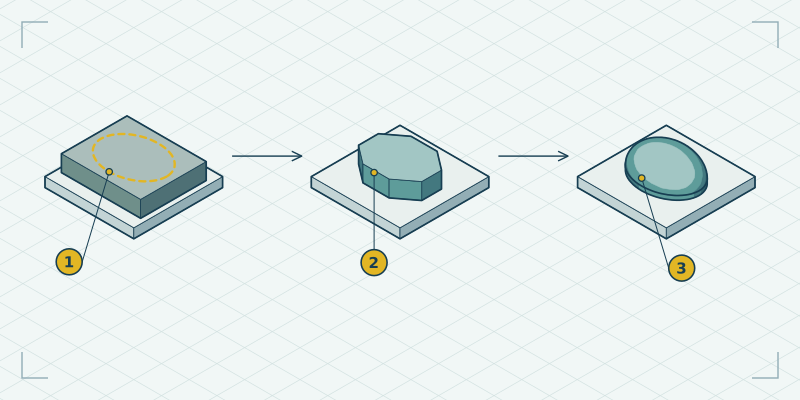
Choose a flat slice of stone, or slab, with a face you want to keep and no visible open cracks or pits. Draw a simple oval or circle on that face. Leave room around the line for the saw cut and later grinding. A small trim saw makes straight cuts close to the outline; a grinding wheel makes the curves. Do not force a straight saw blade around a curve. CabKing's illustrated guide shows these steps.
The roughly cut piece is called a blank. A handle attached with wax, called a dop stick, can help you hold a small blank. You may not need one for a larger stone you can control safely. Keep your fingers clear of the moving wheel and follow the machine's instructions for guards and hand rests.
Shape the outline and dome
Use a coarse wheel to reach the outline, then round the top into a smooth curve called a dome. Turn the stone as you work so one part does not become flat. Keep water flowing where the stone meets the wheel. The right wheel and pressure depend on the machine and stone; start with the maker's instructions.
Stop and dry the stone. Check the outline from above and the rounded top from the side. A lopsided outline or flat spot is easiest to correct now. The cabochon drawing shows the rounded top and flat back.
Sand, dry, inspect
Move to finer wheels one at a time. Each wheel should remove the marks left by the previous one. Clean the stone and your hands between wheels, then dry the stone and inspect it under a good light. Water can hide scratches. A fine wheel or polish will not reliably remove a deep scratch from rough grinding.
Wheel labels give a grit number: higher numbers usually mean finer particles. CabKing's current six-wheel package runs from 80- and 220-grit grinding wheels through 280-, 600-, 1,200- and 3,000-grit smoothing wheels. Other machines and stones need different choices. Check the wheels fitted to your machine against the wheel guide. CabKing 6V3 manual; wheel order explained.
Polish the stone
Start polishing only when the dry stone looks smooth and free of scratches. Use a pad and polishing paste or powder suited to the stone, and follow the maker's wet-use instructions. Check the stone as you work. If a mark remains, return to a sanding wheel that can remove it; more polish will not fix a deep scratch. CabKing describes one pad-and-paste method.
The back may need flattening so the stone sits in a piece of jewellery. A flat grinding disc, called a lap, can do that job. Some cabbing machines accept one as an attachment; confirm that it fits before buying one.
If something looks wrong
| What you see | What to check |
|---|---|
| One side is higher | Compare the outline and dome from several angles. Return to shaping before using finer wheels. |
| Deep scratches remain | Dry and inspect the whole face. Return to the wheel that can remove the deepest marks, then repeat the finer stages. |
| Fine scratches reappear | Clean the stone, hands and work area. Coarse grit carried to a fine wheel can mark the surface. |
| The polish stays dull | Check for scratches first. Then check that the pad, compound and method suit the material. |
Wear eye protection, keep water flowing and keep electrical connections dry. Wet methods reduce dust but do not make every exposure safe. CabKing safety instructions; US workplace safety guidance on silica dust.