Checked 22 September 2026
Cabbing wheels, sanding belts and expanding drums
The grit number tells you how coarse a wheel is. Its size and centre hole decide whether it fits your machine. Some machines use a rubber drum with replaceable sanding belts instead of a grinding wheel.
Choose the working surface
A hard diamond grinding wheel removes material to establish the outline and dome. A cushioned resin sanding wheel follows that shape while removing scratches from the previous grit. An expanding rubber drum holds a replaceable abrasive belt when rotation expands its slotted rim. It gives a compliant sanding surface, but belt length and width must fit that drum.
Crystalite's Crystalring, Diamond Pacific's Galaxy and Nova, and Covington's expanding drums come from three makers with their own sizes and holes; a wheel from one does not replace another by name. The machine guide explains where each stage fits.
Three current systems
| Family | Construction and use | Current source |
|---|---|---|
| Crystalite Crystalring | Electroplated diamond on a seamless steel rim for grinding and preforming | Crystalite brochure, printed page 10 |
| Diamond Pacific Galaxy / Nova | Galaxy for grinding; cushioned resin-bond Nova for sanding | Nova range and Galaxy listing |
| Covington expanding drums | Rubber drums grip replaceable sanding belts while turning | Two-station and four-station machines |
Crystalite's current brochure gives Crystalring a one-inch hole and lists it at 4 × 1½, 6 × 1, 6 × 1½ and 8 × 1½ in. Diamond Pacific sells Galaxy and Nova wheels in four diameters from 2⅜ in; at the largest, 7⅝ in, the Nova is 2 in wide and the Galaxy 1½ in. See the Diamond Pacific reference before ordering wheels for a Diamond Pacific machine.
Measure the assembly before the abrasive
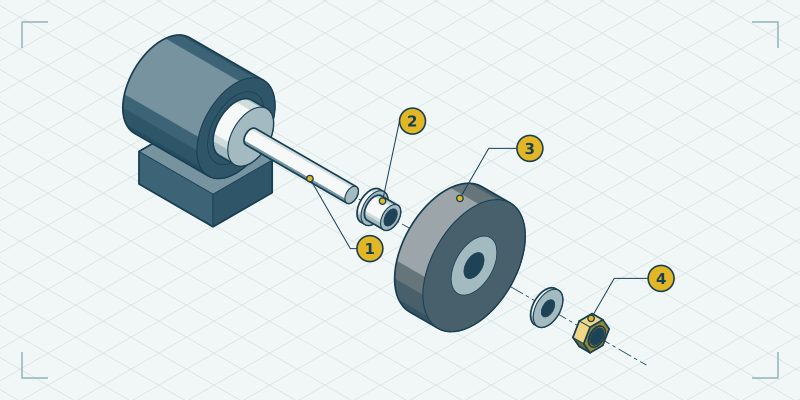
Write down the wheel's outside diameter, width, bore and grit. Then record the shaft or adapter diameter, spacers, side of the machine, hood clearance and any threaded attachment. A bushing may reduce a large wheel hole to fit a smaller arbor, but the wheel and machine makers must specify the arrangement. Do not infer a fit from "six-inch wheel" alone.
For a drum belt, record drum diameter and face width, then use the machine maker's belt length or part number. Both current Covington units use 8 × 3-inch drums, and Covington's drum-unit instructions (PDF) give 3 × 25-7/32-inch belts for both.
Old models may share a name but not a drive
Covington's model number 454EDU covers two different drives. Its 2011 page lists the 454EDU with both drums on a ⅓-horsepower double-shaft motor. The current two-station unit keeps the number but mounts the drums on a separate pulley-driven shaft with sealed bearings and a ½-horsepower motor. The instructions linked from that listing still describe the older direct drive, so photograph a used 454EDU's drive before buying bearings, shaft parts or a replacement motor.
Run abrasives with the water and speed the manufacturer specifies. Crystalite's brochure says never to run its diamond products dry. It designs Crystalring for 1,725 rpm, and its speed table recommends 2,500 rpm for four-inch wheels, 1,725 for six-inch and 1,400 for eight-inch. Other makers set their own speeds. Keep the stone, hands and pans clean when moving from coarse grinding to fine sanding.