Checked 22 September 2026
Combination lapidary machines and arbors
A combination machine puts a saw, grinding wheels and finishing tools on one base. An open arbor is a wheel-carrying shaft that you equip yourself. Check what comes with either machine, including its water supply.
One bench can hold several operations
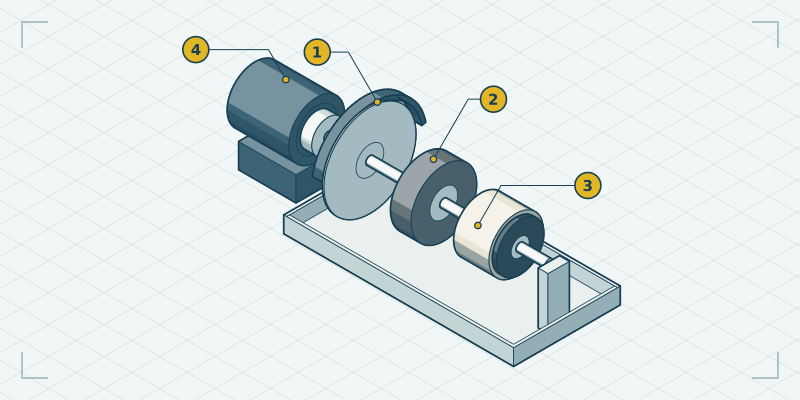
A combination machine can trim rough, grind an outline, sand a dome and polish on attached stations. It is useful when bench space is tight or the operator wants one integrated water and drive setup. A stand-alone cabber often provides more wheel stations, while a separate saw can cut without occupying the grinding bench. Compare the jobs and included attachments before comparing price.
An arbor supplies the shaft and bearings, and the owner chooses the wheels, heads or drums. An arbor listing may omit the motor, abrasives, hood, pan and water feed, so its price is rarely the cost of a working bench.
What current combination packages include
Covington's six-inch Diamond Combination Unit lists a six-inch saw blade and vise, two metal-bond grinding wheels, an expanding drum, belts, polishing head, water valves and drains. Its 100- and 220-grit hard wheels do the early shaping; belts and polishing equipment handle later stages. Covington marks the silicon-carbide package unavailable.
The eight-inch Deluxe Combination Unit has separate saw and grinding motors. Its current diamond package includes a ten-inch trim saw, two grinding wheels, a drum and polishing heads. Check the exact included abrasive grades, electrical supply, lead time, freight and bench dimensions with Covington before buying; the manufacturer can change the package.
Older units carry earlier model numbers. Covington's 2010/11 catalogue sold the six-inch unit as the 494, with 100- and 220-grit silicon-carbide wheels, or the 495, with diamond wheels, belts and compound close to today's diamond package. Both had a six-inch blade, slab vise, expanding drum, leather polisher, 1/3 hp motor and speed control from 800 to 1,725 rpm. The same page shows 8- and 10-inch horizontal combination units, the 690 and 691, sold with or without a motor.
An arbor needs a complete parts list
Covington's two-station open arbor accepts six- and eight-inch wheels and has threaded ends for compatible heads. The maker says it does not include wheels or a motor. Its closed arbor comes with a 1- or ¾-inch shaft. Both ship with nuts, flanges, a drive pulley and a V-belt. You still supply the wheels, motor, guard and water system, and match each wheel's bore to the shaft.
The current 592 variable-speed grinder/polisher includes a motor, hoods, pans and water valves, but Covington says it ships without wheels, drums or aluminium heads. A complete-looking machine can still need its most expensive consumables. Get an itemised quote for the configuration you intend to use.
Rock Rascal letters mark the configuration. Johnson Brothers' 2010 catalogue sold the six-inch P arbor without a motor and the PM with one; both take wheels or drums up to 6 by 1½ inches. The T and TM combination units, again without and with a motor, added a six-inch saw blade, a 100-grit silicon-carbide wheel, an aluminium polishing head and felt, sanding and rubber discs. Johnson Brothers still lists the RR-TM saw/grinder; check its present package with the maker. The JB Pro is a separate three-station grinder, so the family name alone does not identify the motor or accessories.
Check each station on a used unit
Photograph the model and motor plates, shaft ends, blade arbor, wheel bores, spacers, guards, pans, water lines and drains. Run the saw and grinder with their approved coolant, checking vibration and leakage at each station. Confirm the saw vise and feed travel, the condition of every abrasive, and which heads or adapters are included. Price missing wheels and belts before deciding that the machine is inexpensive.
A used machine may have lost or swapped its original motor and accessories. Identify it from the plate, then compare what is fitted with the maker's package description. The saw guide and wheel guide cover the two largest replacement decisions.