How cabbing machines work
A cabbing machine spins grinding and sanding wheels to shape and smooth stone. Water flows over the wheel while you work. Wheel sizes, wheel order and the water supply all matter when you choose a machine.
The main parts
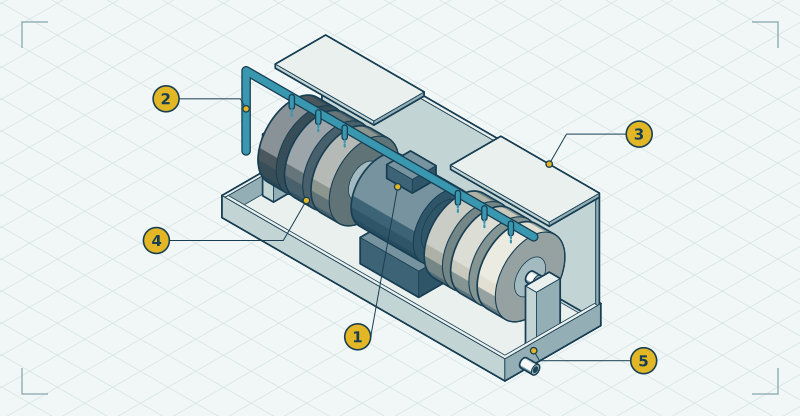
The motor turns a metal rod called a shaft. The grinding and sanding wheels sit on that shaft. Water cools the stone and helps keep dust down. The hood limits splashes, and the tray catches water mixed with ground stone. Each machine routes water differently. The CabKing 6V3 manual shows one labelled example.
Why the wheel order matters
Coarse wheels remove stone quickly. Finer wheels smooth away the scratches. The number printed on a wheel is its grit: lower numbers are coarser and higher numbers are finer. One CabKing six-wheel setup, for example, has 80- and 220-grit grinding wheels, followed by 280-, 600-, 1,200- and 3,000-grit smoothing wheels. A used machine may have different wheels. CabKing 6V3 manual, machine details; the wheel guide covers replacements.
Dry the stone to check for scratches before moving to a finer wheel. Clean the stone and your hands between stages so loose grit does not make new marks. For the final shine, use a polishing pad or flat disc with a paste or powder suited to the stone. CabKing's cabbing guide shows one complete sequence; the polishing reference covers pads and compounds.
Choose a size and a first setup
Makers sell cabbing machines with four-, six- and eight-inch wheels. Both makers below fit the same six grits at every size, from 80 to 3,000. The wheel size sets the weight, the bench space, the cost of replacement wheels and the size of stone you can work comfortably.
| Machine | Wheels (diameter × width) | Weight | Space | Listed price (USD) |
|---|---|---|---|---|
| Diamond Pacific Pixie | 4 × 1¼ in | Under 30 lb with lamp | 14½ × 18 in baseboard | $2,250 |
| Diamond Pacific Genie | 6 × 1½ in | 68 lb listed | 13½ × 29¾ in baseboard | $2,950–$3,075 |
| CabKing 6" | 6 × 1½ in | About 60 lb | 3 × 2 ft of clear bench | $1,499 (110 V) |
| Diamond Pacific Titan | 7⅝ × 1½ in grinding; 7⅝ × 2 in sanding | 148 lb listed | 16 × 42 in baseboard | $4,615–$4,895 |
| CabKing 8" | 8 × 1½ in grinding; 8 × 2 in sanding | 150–160 lb | 4 × 2 ft of clear bench | $2,499 (110 V) |
Diamond Pacific listings for the Pixie, Genie and Titan, with wheel and baseboard sizes from its 2020 catalogue, pages 2, 4 and 6. The listed Genie and Titan weights sit close to the 2020 catalogue's shipping weights of 73 lb and 151 lb, so treat them as upper limits. CabKing listings for the 6-inch and 8-inch machines and its wheel listings, with weights and bench space from the listings and the CabKing manuals. Delivery and tax may add to the listed prices.
Larger wheels cost more to replace. On 22 September 2026, Diamond Pacific listed its 600-grit Nova wheel at $150 in the four-inch size, $180 in the six-inch and $275 in the 7⅝-inch; CabKing listed its resin wheels at $75 for six inches and $100 for eight. A larger wheel gives more working surface: CabKing says its 8-inch machine takes larger stones because its wheels are wider and further apart. At the small end, the four-inch Pixie needs no plumbing and suits a small workspace, but it takes only attachments up to four inches across. The Diamond Pacific and CabKing references compare each range in more detail.
Cabbing machine, flat lap or combination unit
A cabbing machine keeps a full set of wheels on its shafts, so you move from wheel to wheel without changing abrasives. A rotating flat lap works one disc at a time and suits flat faces and cab backs; with a suitable sequence of discs it can also shape a cab. A combination unit puts a saw beside grinding and finishing stations on one base. Compare the flat lap types and the combination arrangements before deciding.
What else a first setup needs
- A way to cut blanks: ready-cut slabs remove the need for a slab saw, but a trim saw still removes waste around the outline. CabKing and Diamond Pacific sell trim-saw attachments for some of their machines. CabKing trim-saw attachment manuals; Genie listing; compare trim and slab saws.
- Dop sticks and wax: for stones too small to hold safely. Dopping supplies.
- Polishing: check whether a pad and compound come with the machine. The CabKing 6V3 includes a canvas pad and 14,000-grit diamond paste; the Genie includes a 14,000-grit Nova disc. CabKing 6V3 manual; Diamond Pacific 2020 catalogue.
- Water: CabKing's pump sits in a 5-gallon bucket of clean water, and the drain tubes run to a second bucket or a drain; CabKing does not supply the buckets. Diamond Pacific's Spra-Mist system needs only a little water poured into the pan. CabKing 6V3 manual; Diamond Pacific 2020 catalogue.
- Eye protection: CabKing and Diamond Pacific both supply safety goggles. CabKing's manual warns that everyday glasses are not safety glasses. CabKing 6V3 manual; Diamond Pacific 2020 catalogue.
New or used
A new machine arrives with the maker's current wheel set and manual. A used machine may cost less, but missing wheels, water parts or adapters can close the gap. Each reference lists what to check for that make: Diamond Pacific, Barranca GP-6 and GP-8, the Rock Rascal JB Pro and combination units. Then work through the checklist below.
What to check before you buy
- Wheel fit
- Measure each wheel's outside diameter, width and centre hole. Check whether replacements need extra rings or adapters, and whether they have room to turn.
- Water supply
- Find out whether water comes from a pump or a raised tank. Check the tubes, taps, drains and trays. Ask to see water reach every wheel.
- Power and space
- Check that the voltage and frequency (Hz) on the motor label match your electricity supply. Measure the bench and leave room for splashes and cleaning.
- What is included
- Count the wheels, lights, guards, flat-disc attachments and polishing pads. Missing wheels and pads can add a lot to the price.
An older machine can differ from today's listing under the same model name. Diamond Pacific's 2020 catalogue, for example, lists pump parts for Titans built from 1978 to 1992, which had a single metal pump; the current Titan has a twin-pump water system. Diamond Pacific 2020 catalogue, pages 6 and 9; identify an older Diamond Pacific machine. Use the comparison table as a starting point, then confirm the machine in front of you with its maker or manual.
Care and cleanup
Follow the manual for guards, water and electrical setup, and never run a grinding wheel dry. CabKing warns that letting a wheel dry out can ruin its surface, and advises moving the stone from side to side so the wheel wears evenly. CabKing FAQ.
Dress a wheel only if its maker says to. Diamond Pacific says its plated Galaxy wheels never need dressing. MK Diamond gives a method for its brazed GP-6 wheels and warns that overdoing it shortens wheel life. Diamond Pacific 2020 catalogue, page 10; MK GP-6 manual; dressing defined.
Feed the wheels clean water and do not pump drain water back to them. Grit in recycled water can scratch the stone and block the valves and nozzles. MK tells owners to change the water and clean the reservoir often; CabKing supplies a pipe cleaner for its nozzles and tubing. MK GP-6 manual; CabKing 6V3 manual.
Do not pour the tray water or sludge down a sink. Hi-Tech Diamond warns that the rock sediment can set like cement and block the drain. Keep the sludge wet while you handle it, because dried stone dust can contain silica. Clean up with water or a dust-rated (M-class) vacuum, not a dry brush, and dispose of the waste promptly. Check local rules for disposing of the settled solids. Hi-Tech Slant Cabber manual; UK HSE guidance on stone dust and slurry.
After each session, switch off and unplug the machine, then clean and dry it. Hi-Tech tells owners to rinse and spin-dry lap and smoothing discs, then store them in a clean, dry plastic bag. CabKing 6V3 manual; Hi-Tech Slant Cabber manual.