
Checked 22 September 2026
Rock Rascal JB Pro Grinder: identification and parts
The older JB Pro Grinder has room for three grinding or sanding wheels. Buyers could choose different wheel packages, so check a used machine's wheels rather than relying on its model name.
The JB Pro in Johnson Brothers' 2010 catalogue
Johnson Brothers' 2010 catalogue, page 29, describes the JB Pro as a six-inch grinder cast in thick aluminium. A cogged belt drives its ¾-inch steel shaft from a ⅓-horsepower motor, and both sit on a ¾-inch board. Its brass and copper water system takes water from a household supply, a submersible pump or a drip system. A surviving grinder may no longer have its original motor or shaft.
Johnson Brothers sold the grinder without wheels as part RR-JPC, with a separate pump kit and a choice of wheel kits. A photograph of an assembled grinder does not tell you which kit, spacers or polishing heads the seller will include.
Three stations, several possible abrasive sets
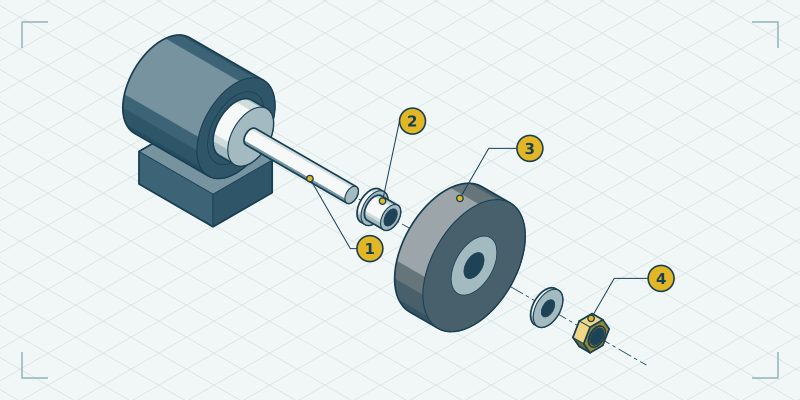
The catalogue gives the JB Pro three wheel stations. The right-hand station takes an expanding drum up to 6 × 2½ in, and the right end of the shaft is tapped ¼-20 for spin discs; a six-inch cast-aluminium polishing disc screws on there. The silicon-carbide kit held 6 × 1-inch green silicon-carbide wheels in 100 and 220 grit, a 6 × 1½-inch drum, 220-, 400- and 600-grit belts, a leather disc and polish. The diamond kit replaced the wheels with 6 × 1½-inch 100- and 600-grit diamond wheels, and the leather with a compound disc and 14,000-grit diamond compound.
Measure shaft and wheel bores, wheel width, spacer stack, drum width and the shaft-end thread before ordering replacements. A nominal six-inch wheel may still have the wrong bore or leave too little clearance under the cover. The wheel and expanding-drum guide covers the parts that most often need replacing.
Ask for a running demonstration
Run the machine with water flowing. Listen for bearing noise, watch each station for wobble and check that water reaches the working face without spilling over the motor. Inspect the drive belt, motor plate, shaft threads, guards and pan. Photograph the complete wheel stack before anyone takes it apart, especially where washers or bushings separate abrasive faces.
Ask the seller to lay out every loose wheel, belt, drum, polishing head, pump and hose. Price the missing parts separately. Do not compare a bare grinder with a ready-to-use cabbing setup on asking price alone.
Separate the JB Pro from current Rock Rascal saws
Johnson Brothers' current Rock Rascal listing offers the JM trim saw and the TM saw with grinder, not the JB Pro. Its repair-parts listing covers the J, JM, T and TM models and lists ½-20 shaft nuts for the TM; the JB Pro has a ¾-inch shaft. Confirm the grinder model and shaft measurements with Johnson Brothers before ordering.
For a mixed saw-and-grinder unit, see the combination-machine guide. The TM has a different layout from the three-station JB Pro.
No JB Pro manual is online
Johnson Brothers publishes no JB Pro manual, and the Currently Rockhounding manual archive has none. The Rock Rascal listing links instruction sheets for the T and TM saw and grinder (PDF) and the J and JM trim saw (PDF); they describe those machines, not the JB Pro. The 2010 catalogue page remains the fullest maker description of the grinder.
For a manual or a part, contact Johnson Brothers with the model name, motor-plate details, shaft measurements and photographs of each station. Manuals for other makers' machines are listed on the parts and manuals page.