Checked 22 September 2026
Flat lap machines and lap discs
A flat lap smooths or polishes a flat stone surface. One type spins a disc while you hold the stone against it. Another vibrates a pan of stones and loose abrasive grains. Their discs, pads and abrasives differ.
The same word covers different work
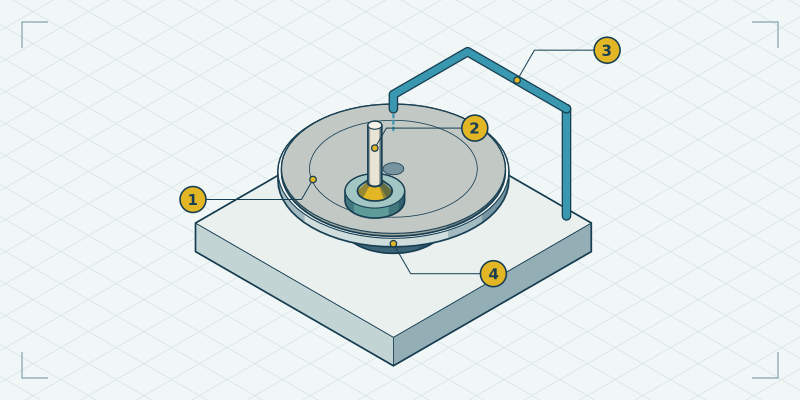
A rotating lap spins a disc against a stone the operator holds and moves. It can flatten a cabochon's back, work an inlay face or shape a cab using a suitable sequence of discs. A vibrating lap moves a pan beneath relatively heavy pieces and loose abrasive slurry. It suits flat saw-cut faces on slabs and geodes; it cannot replace hand control on a dome.
The machine, abrasive and backing depend on each other. Choose the machine for the surface you need to finish, then choose the abrasive and backing that fit it.
Rotating laps for controlled work
Hi-Tech Diamond still sells the All-U-Need rock/mineral flat lap in six- and eight-inch versions. Its current kit includes an electroplated 180-grit lap, 325, 600 and 1,200-grit smoothing discs, a polishing pad, diamond paste and backing plates. The machine uses a water kit. An older All-U-Need may have come with different discs.
Check the lap diameter, arbor or centre hole, backing plate and water route together. The current replacement arbor has a half-inch lap hole and fits both current six- and eight-inch All-U-Need units, but Hi-Tech asks owners of older machines to confirm fit. A disc's abrasive face alone tells you nothing about its mounting.
Vibrating laps use loose grit
Covington lists its Vibra Lap in 10-, 12- and 16-inch sizes. The maker says the pan vibrates beneath the work, and it supplies a removable pan, bumper ring and polishing pad. Its instructions specify loose abrasive grit and say the machine does not work with diamond or silicon-carbide pads. A rotating lap's stick-on smoothing discs are therefore the wrong consumable for this machine.
Start with a relatively flat saw cut, level the machine and follow its loading, water and grit instructions. Clean the pan and stone thoroughly between grades. Check the stated weight and pan size for the amount of material you plan to process; a larger diameter does not by itself tell you the load limit.
Older vibrating laps often turn up used. Raytech's 2000–01 price list sells the Hustler lap as the H-15D, with grooved and smooth pans, a bumper ring and a polishing pad as separate parts. Diamond Pacific's 2005 catalogue describes the DL-18 Double Deck, which holds two 18-inch pans on brackets: the top pan polishes on its own pad while the lower one grinds. The same page lists the rough and smooth pans, springs, spider and motor as separate parts. Diamond Pacific currently describes its 20- and 27-inch Vi-Bro-Laps as grooved-plate machines for flat geode and slab faces. Check the specific model's pan, plate, pad and motor before ordering replacements.
How laps attach
Flat-lap consumables include electroplated diamond plates, resin smoothing discs, magnetic laps, felt or leather pads and loose-grit pans. A Magnetic Nova lap clings to a cast-iron, steel or nickel-plated lap; Diamond Pacific says it will not work on aluminium or a diamond-coated surface. Other pads use adhesive or a backing plate. Match diameter, centre hole, substrate, cushion, water instructions and grit sequence before ordering.
Once the scratches are gone, a final polish needs a suitable pad and compound. Keep each grade separate so coarse grit cannot contaminate the next stage. The polishing guide covers pads and compounds; the first-cabochon guide shows where a flat back fits into the work.